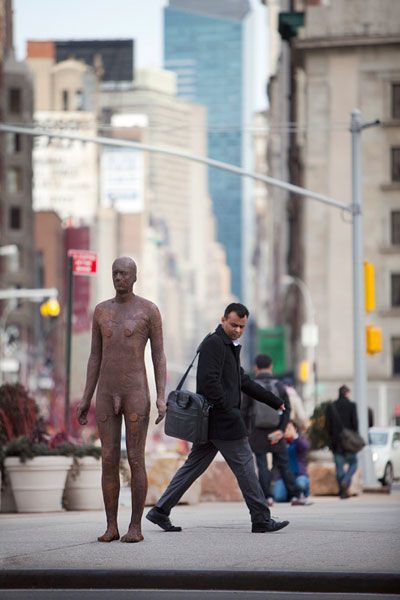
From March 26 to August 15 2010, Antony Gormley's Event Horizon can be seen amongst the bustling streets of Manhattan. The Madison Square Park Conservancy presents the installations on the streets and on top of buildings, much like Gormley's 2007 installation of the figures in London. The thirty-one life size iron 'blokes' gaze at passes by from above and at eye level. Their outlined shapes ask the public to look up from their everyday comings and goings on the street level and question their existence amongst the ever flowing crowd of humans that bombard the city's streets every day. Just as with Doug Aitken's Sleepwalkers, it is the flaneuristic viewpoint that is explored (although I have found no evidence of Gormley using this connection to Psychogeography), suggesting an awakened awareness of self in relation to everyday surroundings and actions. Gormley's perception of this piece has greatly intrigued me, (quotes below), with his unspoken (maybe unaware?) connection to the psychogeographical viewpoint of looking at the relation between a "visually overburdened world" and oneself.


"The art of our time is absolutely and fundamentally different that everything that went before. It's not about the known; it's about the unknown. It's not about reinforcing all of those things that give comfort and certainty; it's about identifying the things that make us uncomfortable, uncertain. It's about, I think, trying to find a space in a very visually overburdened world in which the subject can find him or her self.
"The whole installation is about making a connection between that which is palpable, that which is perceivable, and that which is imaginable. So on the floor, as an interruption of the flow of daily life on the street, we have four 650 kilo iron blokes that are gunna stand naked on the pavement and people will stop and say "What the ___ is that thing doing here?" And that transfer of awareness then might lead to looking around and then that's the point at which, "Oh my God, there's not just one there are more - what's happening here?"
I'm just feeling the magnificance of this extraordinary built environment. It's an awesome sight. I think Manhatten remains a living laboratory of possibility of how human beings can live together.
And then I'm very interested in what happens up there and the question is "Where are they gunna look? How are they gunna orientate themselves, in some sense, their position in this field of visible, of gazing and being gazed, and become enhanced?"
Antony Gormley, February 25 2010, Mad. Sq. Park Conservancy


"The art of our time is absolutely and fundamentally different that everything that went before. It's not about the known; it's about the unknown. It's not about reinforcing all of those things that give comfort and certainty; it's about identifying the things that make us uncomfortable, uncertain. It's about, I think, trying to find a space in a very visually overburdened world in which the subject can find him or her self.
The condition of sculpture is it's still silent or mute and has no meaning, it's just a thing, it's completely useless, it's just an object in a space and it waits for all the things it doesn't have: consciousness, feeling and freedom - and that's what you've got.
Places for reflection, it's the most important experience, I mean, the most important thing - a place within life that is, in a way, removed from life, from which we can loom out but also look in. I would say that you are the subject in a field that is created by art and you, in some sense, make the picture because the picture is not given - it hasn't been done for you, it's an open work that you give form to.

And where is the artwork?
Is the artwork in the moment of its origination?
Is it in the moment of its reception?
It's everywhere.
I would say the artwork exists most potently in the memory of the viewer or the one who has experienced it."
Antony Gormley, June 19 2009, The Art Fund UK


