31 March 2010

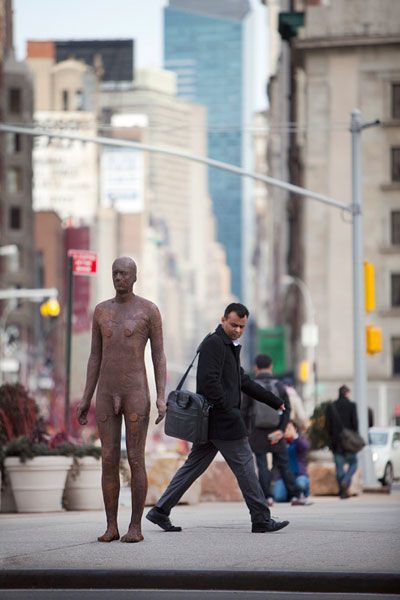
Antony Gormley's 'Event Horizon' 2010, New York

 From March 26 to August 15 2010, Antony Gormley's Event Horizon can be seen amongst the bustling streets of Manhattan. The Madison Square Park Conservancy presents the installations on the streets and on top of buildings, much like Gormley's 2007 installation of the figures in London. The thirty-one life size iron 'blokes' gaze at passes by from above and at eye level. Their outlined shapes ask the public to look up from their everyday comings and goings on the street level and question their existence amongst the ever flowing crowd of humans that bombard the city's streets every day. Just as with Doug Aitken's Sleepwalkers, it is the flaneuristic viewpoint that is explored (although I have found no evidence of Gormley using this connection to Psychogeography), suggesting an awakened awareness of self in relation to everyday surroundings and actions. Gormley's perception of this piece has greatly intrigued me, (quotes below), with his unspoken (maybe unaware?) connection to the psychogeographical viewpoint of looking at the relation between a "visually overburdened world" and oneself.
"The whole installation is about making a connection between that which is palpable, that which is perceivable, and that which is imaginable. So on the floor, as an interruption of the flow of daily life on the street, we have four 650 kilo iron blokes that are gunna stand naked on the pavement and people will stop and say "What the ___ is that thing doing here?" And that transfer of awareness then might lead to looking around and then that's the point at which, "Oh my God, there's not just one there are more - what's happening here?"
I'm just feeling the magnificance of this extraordinary built environment. It's an awesome sight. I think Manhatten remains a living laboratory of possibility of how human beings can live together.
And then I'm very interested in what happens up there and the question is "Where are they gunna look? How are they gunna orientate themselves, in some sense, their position in this field of visible, of gazing and being gazed, and become enhanced?" 
Antony Gormley, February 25 2010, Mad. Sq. Park Conservancy 


 "The art of our time is absolutely and fundamentally different that everything that went before. It's not about the known; it's about the unknown. It's not about reinforcing all of those things that give comfort and certainty; it's about identifying the things that make us uncomfortable, uncertain. It's about, I think, trying to find a space in a very visually overburdened world in which the subject can find him or her self.

The condition of sculpture is it's still silent or mute and has no meaning, it's just a thing, it's completely useless, it's just an object in a space and it waits for all the things it doesn't have: consciousness, feeling and freedom - and that's what you've got.
Places for reflection, it's the most important experience, I mean, the most important thing - a place within life that is, in a way, removed from life, from which we can loom out but also look in. I would say that you are the subject in a field that is created by art and you, in some sense, make the picture because the picture is not given - it hasn't been done for you, it's an open work that you give form to. 
And where is the artwork?
Is the artwork in the moment of its origination?
Is it in the moment of its reception?
It's everywhere.
I would say the artwork exists most potently in the memory of the viewer or the one who has experienced it."
Antony Gormley, June 19 2009, The Art Fund UK

21 March 2010

Oh, Peter Greenaway, how I adore thee...


Peter Greenaway, painter, film maker, performer, installationist and welsh.

His influence has become apparent in my filmwork since watching a collection of his early short films in the second year of my course. His use of lists, narration and everyday themes/scenes (although some maybe closer to his theatrical fascination - 'The Draughtman's Contract,' 'The Cook, The Thief, His Wife and Her Lover,' etc.) examplify his transition from painting to moving image. There is no doubt that as an art student I have been brought along the parameters of education to follow the 2D form of art and, having given the chance and option on my university course, applied my painting/drawing knowledge to the moving image in my transition from 2D work to the medium of new media. Greenaway has continued to work with painting and drawing, even incorporating his images into his early film work (e.g. 'A Walk Through H,' 1978)


There's no earthly way of knowing
Which direction we are going
There's no knowing where we're rowing
Or which way the river's flowing
Not a speck of light is showing
So the danger must be growing
Are the fires of Hell a–glowing
Is the grisly reaper mowing
Yes, the danger must be growing
For the rowers keep on rowing
And they're certainly not showing
Any signs that they are slowing.
'The Rowing Song' by Roald Dahl

Inspired by Peter Greenaway's Water Wrackets this short film was an editing experiment to see if I could create a sense of building water swirling across the screen. Water has been a recurring theme to all my previous film work, with the opening quote that flashes onto the screen a previously used Roald Dahl poem in Robinson in Cardiff. The forever flowing and never ending qualities of the course of water in this world pose endless possibilities that are constant and yet completely changeable. The many paths water can take and its power to surge through anything that stands in its way are qualities that I believe some of us have and apply to our lives. I am not an Aquarius (although I'm sometimes on the cusp of Capricorn and this water sign) but I would like to think I can apply these virtues to my film work as well as my life.

The constant and the endless; the banal and the beautiful.

'Sleepwalkers' by Doug Aitken

An installation feature that has inspired me over the past few years of my university degree - Sleepwalkers by Dog Aitken, 2007.
I first read about this installation in my first year of uni. It has cropped up in every sketch book I have written since 2007. The installation took place in New York at the Museum of Modern Art. Seven screens comprised the piece, each shown on the exterior walls of the MOMA building. For passes by on the busy New York sidewalks the art work was made available to those who may not have even been visiting the museum or exhibition. Times Square bombards the pedestrians of New York with advertisements that are displayed in the way Sleepwalkers was presented, offering a view of life through new media. The moving images Aitken presented on the screens involved seven different lives that, through his editing, shared everyday actions that were similar. From waking in the morning and turning on lights to the universal rise and set of the sun, Aitken presents the idea that although each of us are isolated in our everyday actions, we are still part of a larger crowd, whose decisions and actions are what define us as individuals. To view these seven screens through the flaneuristic view of how the camera has presented them we are each able to make connections to the everyday actions that are usually overlooked in their reality. The simplicity of what has been filmed clearly helps us to relate to the actors presented to us but it is the experience of the passes by (who perhaps originally had no intention of viewing Aitken's installation) that, I believe, this piece was intentionally presented for. For the passes by who can be seen in Karl Kels Sidewalk (see Sidewalk by Karl Kels blog), to put their lives on hold for even a second to look up at the images presented on the side of the MOMA and realise they are not just advertisements of an artists work but that they are the highlights of actions of their own lives. To look at their own simple actions brings psychogeography to the streets of New York in a subtle yet understated way that gives the pedestrian the chance to realise (if just for that moment) the wonderment of their actions as less banal everyday occurrences.
We have a world of pleasurs to win and nothing to lose but boredom.
 Raoul Vaneigem, The Revolution of Everyday Life
Installation views;
The piece featured actors Tilda Swinton, Donald Sutherland, Chan Marshall (Cat Power), Seu Jorge, and Ryan Donowho.

Longer video of the installation;